


Become a Hertz Gold+ member


09/06/2018 • 6 Mins
Top 10 Warsaw Attractions
Warsaw’s past can be read as a tale of turmoil. It’s a city that was razed to the ground in World War Two, and has often been subject to a tug-of-war between neighboring nations. But it’s this tumultuous history that also gives the city much of its character.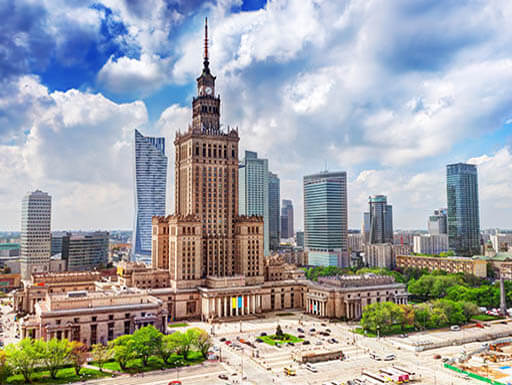
Warsaw is where you’ll find brutalist Communist-era monoliths standing side-by-side with Gothic revival architecture, as well as the modern buildings that show the green roots of the new, post-USSR Poland. It’s a city that isn’t afraid to address its past, while looking brightly to the future. See the very best of what the city has to offer with our guide to the top 10 things to do in Warsaw.
Palace of Culture and Science
This vast Communist-era building – to this day Poland’s tallest – is something of a divisive presence among Warsovians. The building’s full name is the Palace of Culture and Science in the name of Joseph Stalin, and it’s that symbolizing of years of Soviet oppression that rankles with many locals. It didn’t help that the 231-meter-tall skyscraper was built while many people nearby were still living in the ruins of war.
The building now has a number of unflattering nicknames, but for visitors it’s an essential part of Poland’s past. The exterior has imposing statues of Copernicus and Marie Curie, while the interior is sumptuously bedecked with marble, gilding and chandeliers. Here, you’ll find bars and theaters, a casino and cinema, as well as museums.
Royal Castle
War-torn Europe was populated by stunning buildings that were destroyed by bombing, or blown up by the fleeing German forces. Many countries quickly started to rebuild these, but Warsaw had to wait until the 1980s, and the fall of Communism, before followed suit with the revival of the Royal Castle.
It had housed the Polish royal family from the 16th century, having earlier been a 14th-century wooden castle. The restoration is wonderful, especially once you’re inside – the stucco of the Great Assembly Hall, stunning paintings and canvases, the marvelous Throne Room and the King’s Apartment with its room full of works by Canaletto. It’s an absolute-must-see.
Lazienki Park
The finest park in Warsaw was, once upon a time, reserved as a hunting ground for the owners of Ujazdow Castle. One of the park’s centerpieces – the Palace on the Island – was a private bathhouse, before King Stanislaw bought the park, palace and all within it in the 18th century, having the grounds extensively landscaped.
Today, thousands of Warsaw residents descend on Lazienki Park to stroll, relax, take in the gardens and water, dine at the restaurants and experience live music in serene surroundings, including at the neo-classical amphitheater.
Wilanow Palace
This grand palace actually emerged from World War Two relatively intact, its baroque interior preserved. The palace’s history begins in 1677, passing through the hands of a number of different owners, all of whom added their own touches, often in different architectural styles.
Get an audio guide in English to add color to your visit, as you wander through the stunning 19th-century White Hall, chapel, library, bedrooms, galleries and the Etruscan cabinet filled with ancient amphorae, or jugs. The Gallery of Polish Portraits covers four centuries of paintings in addition to sublime furniture.
Warsaw Rising Museum
Warsaw endured some terrible privations under Nazi and Soviet occupancy in World War Two, and this nation’s pivotal role in the outcome of the war can never be overestimated. The Museum of the Warsaw Uprising brings to light and honors the tenacity of those who fought for the city’s freedom in its darkest days.
It does this admirably and inventively, with an attempt to recreate a sense of the conditions that drove the desperate rebellion, brought to life with multimedia, archive material, accounts from those in the city at the time and a Liberator bomber plane.
Chopin Museum
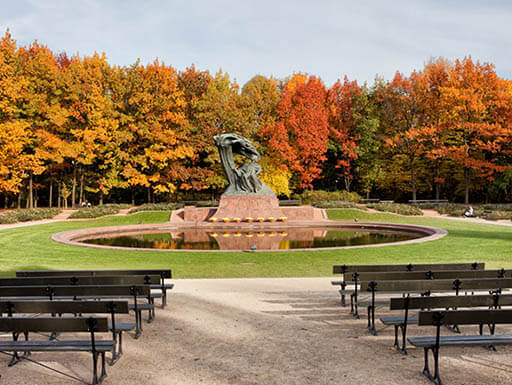
The great composer Fryderyk Chopin was born close to Warsaw and grew up in the city. Admirers of the man who wrote the Minute Waltz can see his funerary monument – containing his heart – at Holy Cross Church, while the four-floor Chopin Museum is state-of-the-art.
Here you can listen to his music and see mementos of his life – including his last piano, a lock of his hair and his school books – in a multimedia environment set in a charming palace. A word of warning, however, it’s best to contact them in advance to book a space, as access can be limited.
Museum of the History of Polish Jews
This museum, with its stunning entrance in a thoroughly contemporary building, opened in 2014. It doesn’t whitewash the history of Jews in Poland and Warsaw itself – it covers the pogroms and the holocaust in detail, in addition to the stories of the first traders and settlers.
Again, an audio guide is the essential way to get a thorough picture of the information on offer, which is presented sensitively but with no little invention. There’s some 1,000 years of history here, which is why the museum is fittingly located at the site of what was once the Jewish ghetto before the events of World War Two.
St. Anne’s Church
Close to Castle Square in Poland’s historic center, the serene, neoclassical façade of St. Anne’s Church hides a difficult past. Constructed in its current form in 1788 (although there has been a church at this site since the 15th century), it looks today pretty much as it did then, albeit with various pieces of reconstruction.
World War Two led to a roof collapse, while post-war tunneling work led to huge cracks that threatened to bring the whole thing toppling to the ground. The interior is breathtaking, with more neoclassical and rococo elements, a viewing tower that affords a magnificent view of the city and a diamond vault.
Copernicus Science Center
It’s difficult to overestimate the role Copernicus played in Renaissance and Reformation science, and the Polish-born astronomer and mathematician’s legacy are celebrated in numerous ways in Warsaw. The 1830 statue of the man became contested when the invading Nazis added a plaque to it during their occupation, implying he was German.
A boy scout later stole the plaque before the statue was removed, although the Poles got it back after the war. There’s also the Copernicus Science Center, a wonderfully interactive museum that’s one of the best places in the world to teach children about science. Look out for the flying carpet, and see if you can outpace a hippopotamus.
Castle Square and Sigismund’s Column
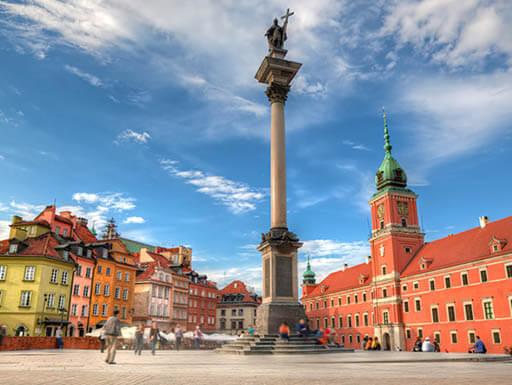
If you’ve visited the Royal Castle, you’ve already passed through Castle Square, but the place itself is worth spending some more of your time. The centerpiece here is Sigismund’s Column, commemorating the king who made Warsaw Poland’s capital at the end of the 16th century, erected in 1644.
The column, originally marble, was renovated numerous times and then replaced by a granite version in the late 19th century. Inevitably, the German invaders destroyed it during the war, and it had to be rebuilt once more in 1949. You can see some of the original remains nearby.
Got a favorite Warsaw attraction that we’ve overlooked? Got an attraction we should be raving about? Lewt us LLet us know about it on Twitter.
Related Articles

10 ways successful people spend their free time
Most people are curious about the productivity hacks and workday schedules of highly successful people – but what about how they spend their free time?
Experience the Grand Canyon at night
Discover the breathtaking beauty of the Grand Canyon at night. Star-filled landscapes are the perfect setting for a memorable visit. Plan today with Hertz.

A Guide to the Best Jazz and Blues Clubs in St. Louis
Whether you’re a jazz and blues fan already or keen to learn more about both genres of music, a visit to St. Louis should be top of your to-do list with a Hertz car rental.
